
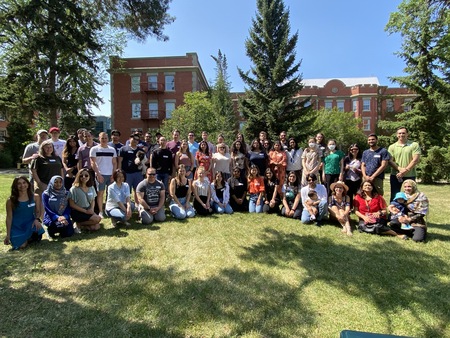
People
Dr.
David Wishart
-Professor
Departments of Computing Science and Biological Sciences
University of Alberta, Edmonton, Alberta T6G 2E8
Office: 341 Athabasca Hall
Phone: (780) 492-0383, Fax: (780) 492-1071
E-mail: david.wishart@ualberta.ca
Grad Studies Opportunities
Dr. David Wishart of the Departments of Biological Science and Computing Science and
Dr. Burim Ametaj of the Department of Agricultural, Food and Nutritional Science are
currently recruiting potential PhD students with a background in analytical chemistry to
work on projects related to profiling of the bovine metabolome. Research involves
characterizing and profiling the dairy cattle metabolome using NMR and Mass
Spectroscopy (GC/MS or LC/MS) technologies. Students will have the opportunity to
work with a team of leading structural biologists and analytical chemists to support
their research objectives. The individual will also have the opportunity to learn and/or
develop cutting edge techniques in NMR and Mass Spectroscopy practices.
A stipend of $24,000 per annum is available to successful candidates.
Please click here for more information.
Projects
Usage Statistics For Our Web Servers
Programs and Databases (Web
Servers)
- HMDB
The Human Metabolome Database (HMDB) is a freely available electronic database containing detailed information about small molecule metabolites found in the human body. The database currently contains nearly 2500 metabolite entries including both water-soluble and lipid soluble metabolites as well as metabolites that would be regarded as either abundant (> 1 uM) or relatively rare (< 1 nM). Additionally, approximately 5500 protein (and DNA) sequences are linked to these metabolite entries.
- PPT-DB
The PPT-DB is a database of databases. It houses more than 20 carefully curated databases, each of which contain commonly predicted protein property information.
- CS23D
CS23D is a web server for rapidly generating accurate 3D protein structures using only assigned NMR chemical shifts as input.
- CCDB
Database
(CCDB)
A comprehensive E.coli specific database, containing genomic,
proteomic
and metabolomic information.
- PROTEUS
A universal protein structure prediction server that will take any query protein sequence and predict the secondary structure, membrane spanning helices, membrane spanning beta strands, signal peptides, and 3D structures.
- PROTEUS2
PROTEUS2 is a protein structure prediction and structure-based annotation software application that provides secondary structure, and if possible, tertiary structure information about one or more query seqeunces. Available as both a web server and a standalone command line interface application, PROTEUS2 creates a single prediction pipeline consisting of: 1) signal peptide prediction, 2) transmembrane helix prediction, 3) transmembrane -barrel prediction, 4) secondary structure prediction (for soluble proteins), and 5) homology modeling (i.e. 3D structure generation). Predictions are performed using a combination of progressive multi-sequence alignment, structure-based mapping, hidden Markov models, neural nets, and up-to-date databases of known secondary structure assignments.
- BASys
BASys (Bacterial Annotation System) is a web server that supports
automated, in-depth annotation of bacterial genomic (chromosomal and
plasmid) sequences.
- BacMap
An interactive visual database containing all publicly available bacterial genomes. A fully labeled and zoomable genome map is provided for each genome. Sequence and text queries can be used to identify genes of interest, or maps can be navigated using a simple interface. BacMap is designed to serve as an intuitive and convenient tool for identifying orthologues and paralogues, studying operon conservation, and determining gene function.
- MovieMaker
MovieMaker is a web server that allows short (~10 sec), downloadable
movies to be generated of protein dynamics.
- DrugBank Database
A database for drug structure and functional information.
- PlasMapper
A web server automatically generates and annotates plasmid maps using
only the plasmid DNA sequence as input.
- SuperPose
SuperPose is a protein superposition server.
- GelScape
GelScape is a web-based gel viewing and annotation system.
- SHIFTX Web
Server
A web server that predicts 1H, 13C, and 15N
protein chemical shifts using the 3D structure (PDB coordinates) of the
protein of interest.
- SHIFTY
Web Server
A web server for predicting protein chemical shifts using only
amino acid sequence information.
- SHIFTZ Web
Server
A web server that calculates 1H, 13C, and 15N
backbone chemical shifts of peptides and proteins
using only their sequence and backbone dihedral angles as input.
- SIMPRED Web
Server
A web server that predicts 1H, 13C and 15N
backbone chemical shifts of peptides and proteins using
only the amino acid sequence and the predicted (known) secondary
structure as input.
- SHIFTCOR
Web Server
A web server that compares, corrects and references chemical shift
assignments using 3D structure (PDB coordinates) of assigned proteins.
- SHIFTOR Web
Server
A web server that predicts protein backbone dihedral angles (phi and
psi) from observed 1H, 13C and 15N
chemical shifts.
- SSASS Web
Server
A web server that allows you to obtain sequential assignments and a 3D
structure for your favorite protein using only its sequence and at
least
one (HNCACB) peak list as input.
- THRIFTY Web
Server
A web server that rapidly generates 3D protein structures (PDB
coordinates) from their corresponding chemical shift assignments
- HOMODELLER
Web Server
A web server that rapidly generates 3D protein structures (PDB
coordinates) from their corresponding protein sequence.
- RefDB
Web-Enabled Database
The Re-referenced Protein Chemical Shift Database (RefDB) is a database
of carefully corrected and re-referenced chemical shifts, derived from
the BioMagResBank.
- PEPMAKE Web
Server
A web server that generates a PDB coordinate file for a polypeptide
using only the sequence and backbone dihedral angles as input.
- VADAR Web
Server
VADAR (Volume, Area, Dihedral Angle Reporter), this web server
quantitively evaluates protein structures using their PDB coordinates.
- PolySearch
Web Server
PolySearch performs multiple types of genome-wide searches, with a
special (but
not exclusive) emphasis on human disease. It also supports PubMed
Literature searches on disease genes as well as gene name searches, SNP
searches, mutation searches and PCR-primer searches.
- RCI
RCI is a Python program that predicts protein flexibility by
calculating the Random Coil Index from backbone chemical shifts (CA,
CO, CB, N, HA) and estimating values of model-free order parameters as
well as per-residue RMSD of NMR and MD ensembles from the Random Coil
Index. Download
Alternative
Mirror
- PREDITOR
PREDITOR is a program for PREDIcting φ, ψ, χ1, and ω TORsion
angles in proteins from 13C, 15N and 1H
chemical shifts and sequential homology. PREDITOR 30o-accuracy of
predicting φ and ψ is close to 90%. The average χ1 accuracy is
84% while the ω accuracy is 99.98% for trans peptide bond identification and
93% for cis peptide bond identification. Overall, the program is 35X faster
and its predictions are approximately 20% better than existing methods.
- SimCell
SimCell is a DCA Cell simulator used to simulate cellular and biochemical processes.The user, through the use of the SimCell Interface may create: small molecules, membrane, membrane proteins, protein/RNA molecules, DNA molecules and Genes. These cellular components can then interact amongst themselves to create fascinating new processes.
- PANAV
PANAV is a Java based structure-independent chemical shift
validation and re-referencing tool. It is based on using residue-specific and secondary structure-specific chemical shift distributions calculated over small (3-6 residue) fragments to identify mis-assigned resonances. The method is also able to identify and re-reference mis-referenced chemical shift assignments. Comparisons against existing re-referencing or mis-assignment detection programs show that the method is as good or superior to existing approaches. Download
Research Staff and Students
Lab Presentation Slides
Programs (Source and Binary)
- JVIEW
A user
friendly program for calculating coupling constants from TOCSY, NOESY,
HMQC traces.
- PHIPSI2CS
A
program for calculating chemical shifts from polypeptide phi, psi
backbone dihedral angles.
- SHIFTY
A program
for predicting protein chemical shifts using only sequence information.
- SEQSEE
A complete
program suite for protein sequence analysis. Runs on UNIX platforms.
- VADAR
A program
for evaluating protein structures (Volume Area Dihedral Angle
Reporter). Runs on
UNIX platforms.
- XALIGN
A program for
aligning multiple protein sequences that uses secondary structure
information in the
alignment process. Runs on UNIX platforms.
- XREF
This is a script based on Varian's MAGICAL language. The macro is
useful for
referencing heteronuclear experiments where no reference signal from an
observable internal standard is available. This macro will reference
`1H', `13C', `15N', `19F'
and
`31P' nuclei up to four dimensions. Please refere to `xref' manual for more information. The
current
version of this macro is V2.0 which
updated on February 9th, 2001 at this server.
- PANAV
A Java based structure-independent chemical shift
validation and re-referencing tool. It is based on using residue-specific and secondary structure-specific chemical shift distributions calculated over small (3-6 residue) fragments to identify mis-assigned resonances. The method is also able to identify and re-reference mis-referenced chemical shift assignments. Comparisons against existing re-referencing or mis-assignment detection programs show that the method is as good or superior to existing approaches.
- Our Download Page
Places
Pictures
Protocols
Courses
Woods Hole
Conference 2005
Book Figures
You are visitor number
(Last
20 users)
This page was last updated on March 6, 2009.
pharmacy, University of Alberta,
Pharmaceutical Sciences, shifty, proteins, peptides, Wishart, Chemical,
Shifts, Chemical Shift Prediction, Bioinformatics, Computer aided Drug
Design, NMR, NMR Spectroscopy, Protein Engineering, Micelles, Peptide
synthesis, Antibody Engineering, Protease, Wishart Pharmaceutical
Research Group - Protein Engineering, Chemical Shift Prediction, NMR
Spectroscopy, Peptide Synthesis, and Antibody Engineering at the
University of Alberta